
When Should Small Shop Owners Raise Prices, and How
What the research says about fair increases, how to find the customer loss you can afford, and a five-step check before you change a price
Abstract
Many owners raise prices late because a raise feels risky and a delay feels free. This paper reviews NFIB and BLS data on current cost pressure, a 1992 Harvard Business Review analysis of price and profit, survey research on which price increases customers see as fair, and a study of how satisfied customers react to increases. It sets out signals that it may be time to raise prices, a five-step Groundwork check, a worked example of how many customers an owner can lose and break even, and how to announce the change. The examples are illustrations, not predictions.
Keywords: when to raise prices; how to raise prices small business; price increase customers; raise prices without losing customers; price increase break-even
Last week the government said prices are up 3.7% over the past year. [2] In September, 20% of small-business owners named inflation their biggest problem. The long-run average for that answer is 7%. [1] Both are national numbers, and your own costs may have moved more or less. But your supplier's invoice probably went up again too. And you are still charging last spring's price, because a raise feels risky and waiting feels free.
It isn't free. Every sale at the old price earns you less than it did. You feel it in your pocket months before you see it on any report. So when is it time to raise prices, and how many customers can you afford to lose?
The short answer
Raise prices when your costs have gone up, your customers are happy with you, and you have a true reason to give. Customers accept a raise they see as fair. Before you decide, work out one number: how many customers you can lose before the raise costs you money. In the example below, a 5% raise can lose about 8 customers in 100 and still break even. Find your number first. Then pick the size.
What the research found
One price change can move profit more than almost anything else you adjust. In a study of 2,463 companies, a 1% price gain with no lost sales lifted operating profit by 11.1%. A 1% gain in sales volume lifted it by 3.3%. [3] Those are averages for large companies and they assume nobody leaves, so use your own numbers.
Customers accept a raise they see as fair. In 1980s phone surveys in Toronto and Vancouver, 79% said it was fair for a grocer to raise lettuce 30 cents a head after its own cost went up. 75% said the same about a landlord whose costs rose. [4] But 82% called it unfair for a hardware store to raise snow shovel prices after a blizzard. [4] The reason matters more than the amount. A raise that tracks your costs reads as fair. A raise that grabs what the market will bear does not. These are old Canadian surveys, so treat them as a guide to the pattern, not a forecast.
Happy customers take it better. A study of customer reactions found that bigger raises and unfair-looking motives both pushed customers away, and that satisfied customers reacted more mildly. [5] It used made-up restaurant scenarios with university students, so it shows a pattern, not a prediction. The lesson for you is a Groundwork judgment, not a finding: raise when service is good, not after a bad month.
Small-business advisers agree on the basics. SCORE, the small-business mentoring group, says to give notice, call it a price increase and not an "adjustment," offer renewing customers the old price for a while, and check what competitors charge. [6] That is practitioner advice, not research, and many of its examples are for business clients.
So what: a raise works best when it is explained, fair and timed for when customers are happy. The next step is knowing your own numbers.
The Groundwork Price Move Check
Any one of these signs is a reason to run the check. These are Groundwork's practical signals, not research findings:
- Your costs rose and your prices did not.
- You are full, or turning work away.
- You have not touched prices in years.
- Almost nobody questions your quote.
Start with your stand-still price. It is the raise that only keeps you where you were. Say a job costs you $40 and that rises to $44. You need $4 more per job just to keep your $60. On a $100 price, that is a 4% raise before you earn a cent more. If you have not raised prices since your costs rose, you are already behind. Many owners start at their stand-still price and add a point or two for what they let slide. That is a Groundwork rule of thumb, not research.
Three parts. Do them in order and write the answers down.
| Part | What to do | The check |
|---|---|---|
| 1. Know your number | Work out your real cost per sale from the last three months: materials, labor, fees and delivery. Then use this: customers you can lose = 1 − (profit per sale now ÷ profit per sale after the raise). | Your free Price Increase Calculator does it in seconds. |
| 2. Pick the size and the timing | Small and steady is easier to defend than one big jump. Raise new customers first, or give loyal ones notice. Raise when service is good. | Wait if you have a service problem you have not fixed, or you are only copying a competitor. |
| 3. Say it plainly, then watch | Tell customers the date, the new price and one true reason. Call it a price increase. Then track orders, cancellations and complaints for 30 days. | Compare what you see to your number from part 1. Adjust from evidence, not fear. |
A worked example
This example is hypothetical. You charge $100 a job. It costs you $40, so you keep $60. Raise the price to $105 and you keep $65.
- You can lose about 8 jobs in 100 (1 − 60 ÷ 65) and earn the same total profit.
- Say you lose only half that, 4 jobs in 100. You are ahead by about $240 for every 100 jobs. (96 jobs × $65 is $6,240, against $6,000 before.)
- On a thinner margin, where each job costs $70 and you keep $30, the same 5% raise lets you lose about 14 jobs in 100.
- Cutting $100 to $95 works the other way. You would need about 9% more jobs just to earn what you earn now.
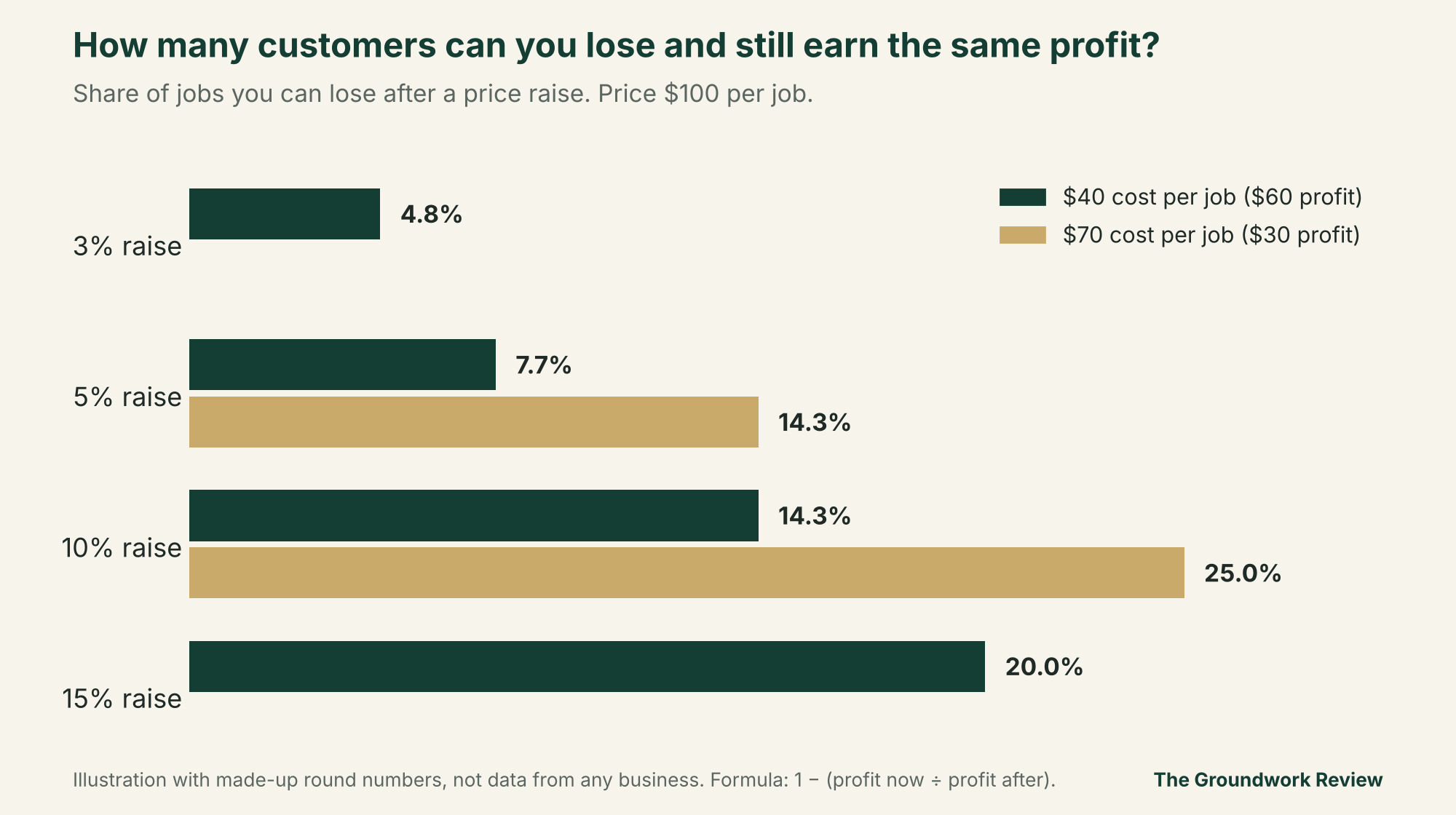
So what: the thinner your margin, the more a raise is worth and the more a discount costs. The number tells you the line to stay above. It does not predict how your customers will react.
What to say
Keep it short and plain. Name it a price increase. Sample wording:
- Counter or walk-in customers: "Prices go up on [date]. Our costs went up, and we held our prices as long as we could."
- Monthly or repeat clients: "Starting [date], your price will be [new price], up from [old price]. If you renew by [date], we will hold your current price for [three months]."
- When someone asks why: Give everyone who talks to customers the same one-sentence answer, and say it only if it is true. A reason that tracks your costs is the one customers accept. [4]
- Do not promise a temporary price you plan to keep. If a fee is temporary, end it on the date you said. [6]
So what: the wording matters less than the date, the number and a reason that is true.
What to do this week
- Pull your last three months of costs and work out your cost per sale.
- Run two or three raise sizes through the free Price Increase Calculator. Not sure how? See How to Calculate a Price Increase.
- Pick the size you could absorb, a start date and one true reason.
- Write the notice: "Starting [date], our price for [service] is [new price]." Give more notice to monthly clients than to counter sales.
- Check orders, cancellations and complaints after 30 days against your number.
Groundwork's final assessment
Waiting is a pricing decision too. It just never gets written down. Raise when your costs have moved, when your customers are happy with you, and for a reason they can see is fair. Know your break-even loss before you do. Some customers will leave, and no research can promise otherwise. Whether you can afford that is arithmetic, not courage. If you have not touched prices in years, one catch-up raise may be needed. After that, small and explained is easier. Run your number this week and decide with your own figures.
Put Groundwork to work for your business
Not sure where your prices stand against your costs and your competitors? A Groundwork Profit & Pricing Tune-Up compares what you charge to what each job costs and what nearby businesses charge, and gives you a pricing plan in writing. It is a fixed $795. Text Groundwork at 501-602-3006 or email info@groundworkbusinessadvisory.com, and your Groundwork adviser will reply.
Anticipated Questions
How much should I raise prices?
There is no single right number. Run the break-even loss for two or three sizes and pick the one you could absorb comfortably. If your costs rose by a known amount, matching it is the easiest raise to explain.
Will I lose customers?
Probably some. Your number shows how many you can lose and still come out even. Satisfied customers, a fair reason and advance notice make the reaction milder, but they do not remove it. [4] [5]
Should I raise prices for everyone at once?
Not necessarily. You can raise for new customers first, or give existing customers notice and a grace period. [6] Choose the one that fits how your customers buy.
What if my competitors are cheaper?
Compare what the customer gets, not only the price. Customers tend to accept a raise more easily when the whole industry is moving. [6] If you are well below nearby shops for the same work, take a closer look.
Is it better to raise once a lot or a little every year?
The sources do not settle this. Small, regular, explained raises are easier to announce. A large catch-up may be needed once, after years of no change. Use your numbers.
References
- National Federation of Independent Business. (2026, October 13). Uncertainty grows and optimism fades slightly on Main Street in September (NFIB Small Business Economic Trends). www.nfib.com
- U.S. Bureau of Labor Statistics. (2026, October 14). Consumer Price Index news release, September 2026. www.bls.gov
- Marn, M. V., & Rosiello, R. L. (1992, September-October). Managing price, gaining profit. Harvard Business Review. pages.charlotte.edu
- Kahneman, D., Knetsch, J. L., & Thaler, R. (1986). Fairness as a constraint on profit seeking: Entitlements in the market. The American Economic Review, 76(4), 728-741. ideas.repec.org
- Homburg, C., Hoyer, W. D., & Koschate, N. (2005). Customers' reactions to price increases: Do customer satisfaction and perceived motive fairness matter? Journal of the Academy of Marketing Science, 33(1), 36-49. journals.sagepub.com
- SCORE. (2022, December 19). How to raise prices without losing customers. www.score.org
- Groundwork Business Advisory. Price Increase Calculator: How many customers can you lose? (free tool). groundworkbusinessadvisory.com
Editorial note. General information, not financial, tax or legal advice. The worked example uses made-up round numbers to show the arithmetic and does not describe any business. The Marn and Rosiello figures are averages for large companies and assume no lost sales. The fairness surveys were telephone surveys in Toronto and Vancouver in 1984 and 1985. The customer-reaction study used hypothetical restaurant scenarios with students at a German university. SCORE's guidance is practitioner advice, not experimental evidence, and many of its examples are for business clients. NFIB and BLS figures are national and may not match any one shop's costs.
Spotted an error? See our corrections policy. Disclosure: Groundwork sells services related to this topic; see conflicts of interest.
How to cite
Woodson, M. (2026). When Should Small Shop Owners Raise Prices, and How The Groundwork Review, No. 18. https://projects.groundworkbusinessadvisory.com/research/when-to-raise-prices-small-shop/